Presidential speeches — how presidents talk
@unwelcomedata · data from public sources
A quantitative look at 1,059 U.S. presidential speeches from 45 presidents (1789→present), drawn from the University of Virginia Miller Center archive. The lead question: do presidents frame things around self (I / me / my) or the collective (we / us / our) — and how has that changed over 230 years?
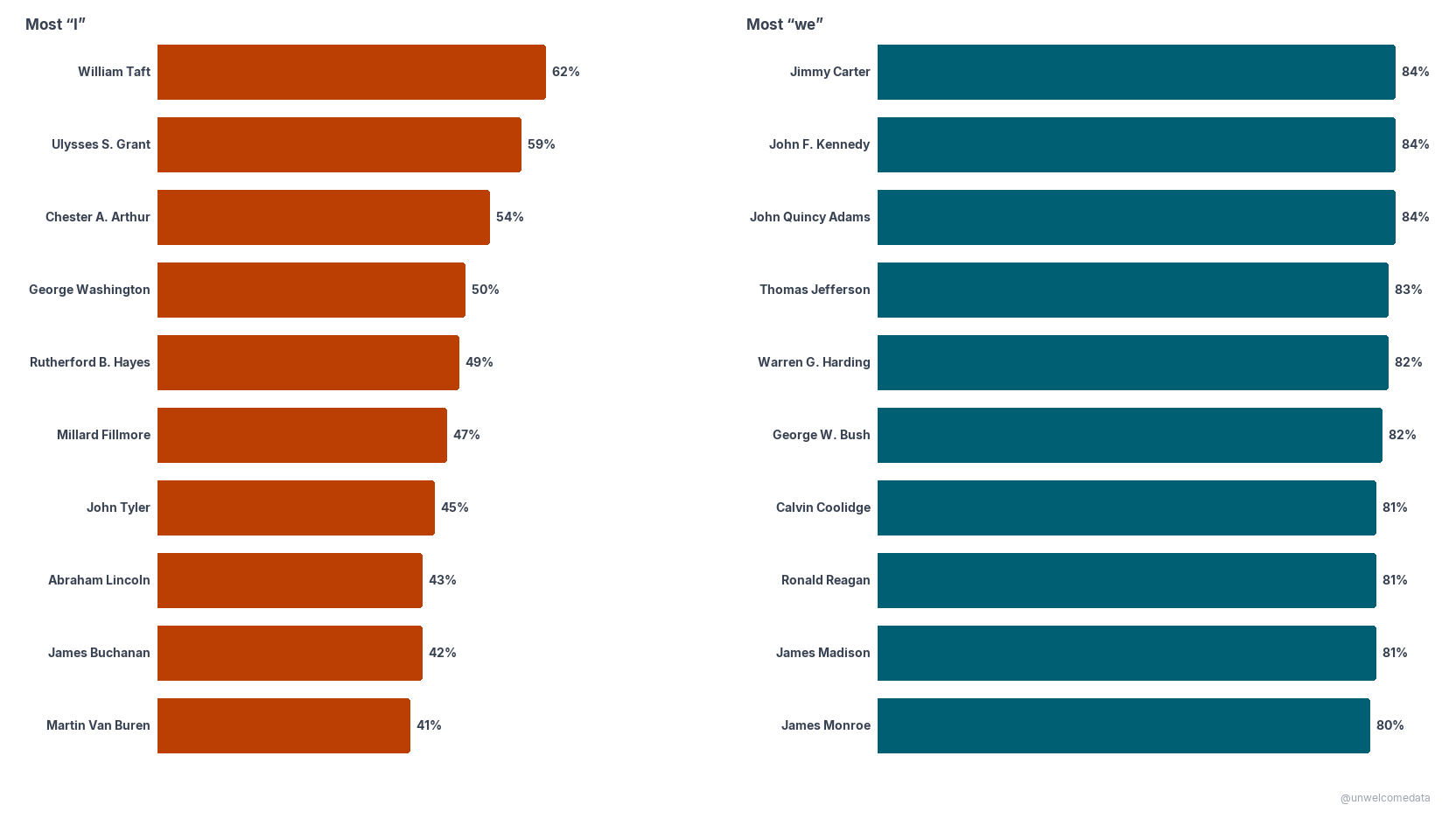
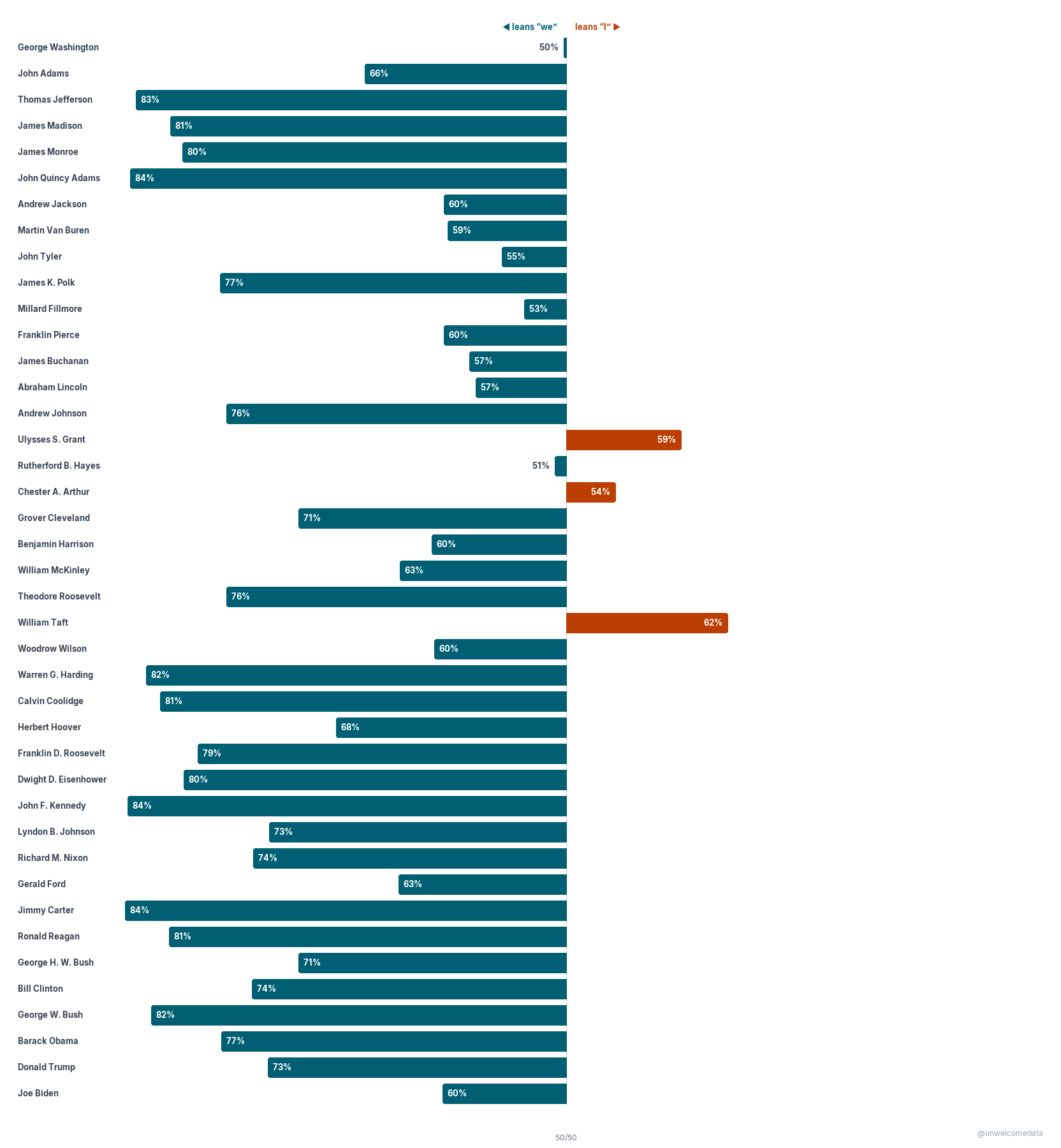
The short answer: the shift over time isn’t rising self-focus — it’s the rise of “we.” In the State of the Union, collective language climbs steeply across the broadcast era while self-reference stays comparatively low. The most “I”-leaning State of the Union presidents are 19th-century (Taft, Grant, Arthur); the most “we”-leaning are modern (Carter, Kennedy).
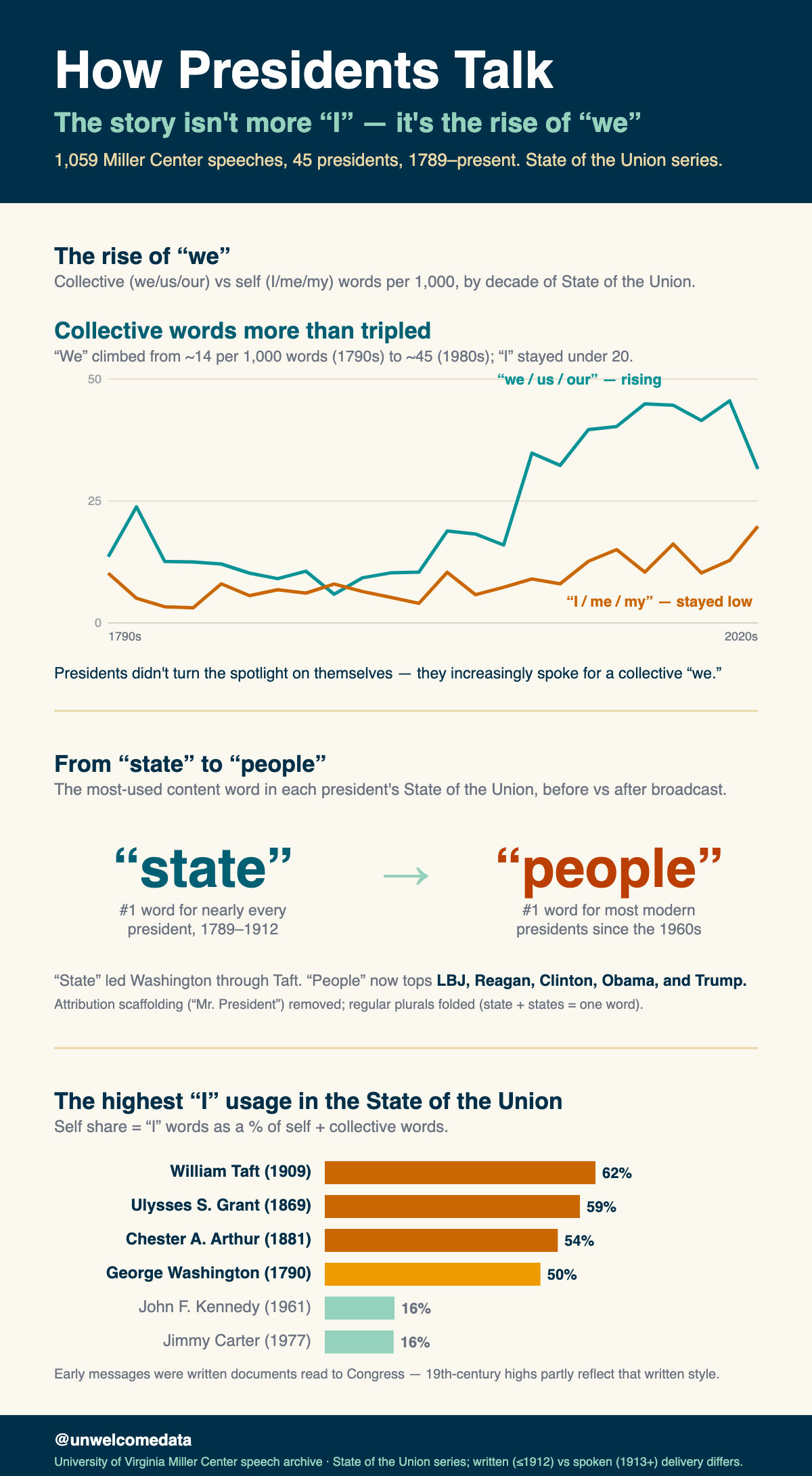
The charts
Each chart is rendered for the web (click any chart to open it full-size). Figures are averages within one speech type — State of the Union or Inaugural — because the self/collective mix depends heavily on the setting, and because the corpus mixes eras (see How it was measured).
State of the Union — self vs collective, by president
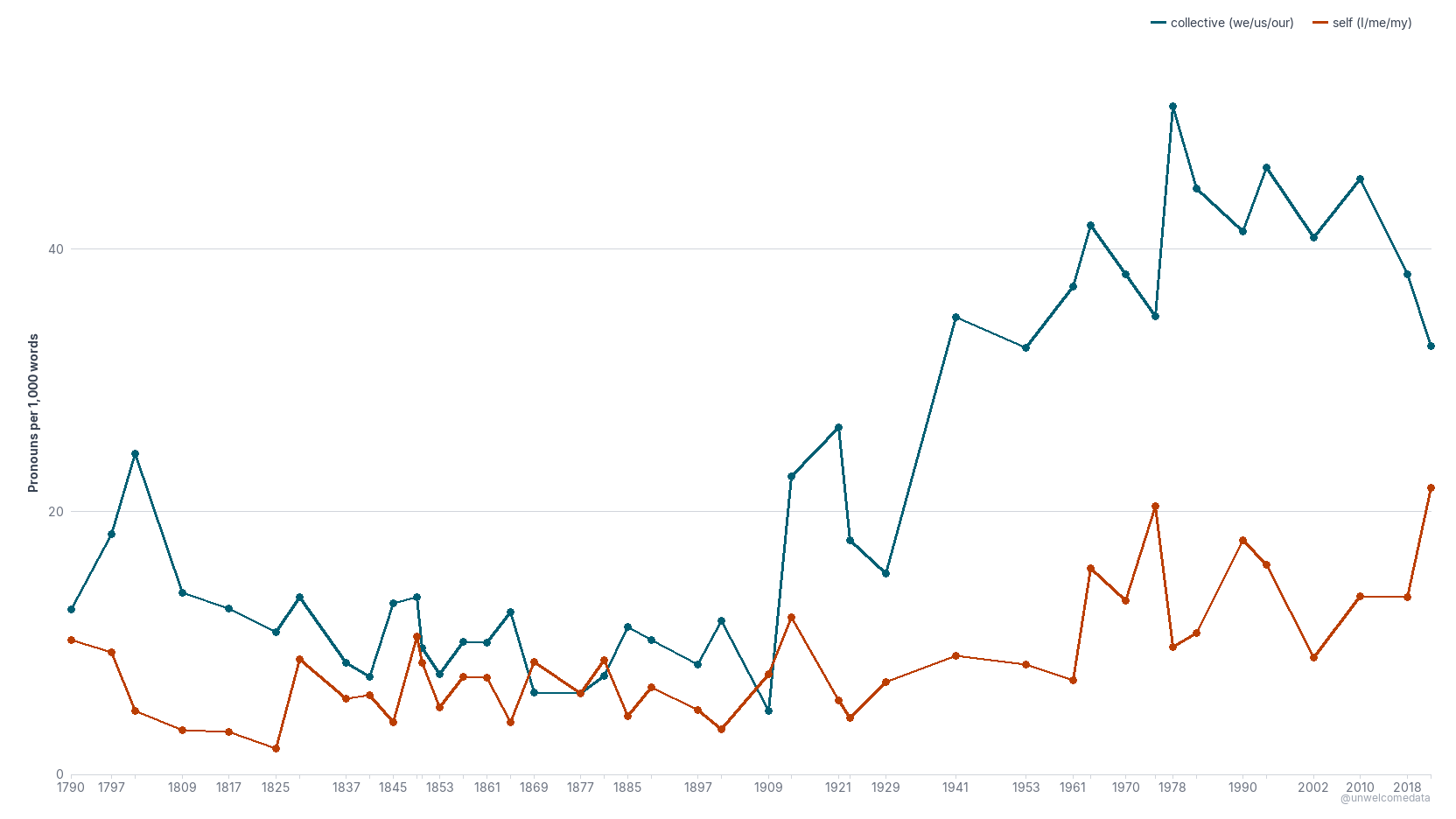
Each dot is one president’s average across their State of the Union addresses (per 1,000 words), placed at their first SOTU year: collective we/us/our vs self I/me/my.
The “I” presidents and the “we” presidents (State of the Union)
Left: presidents whose SOTU first-person pronouns are most often “I” (share that are “I”). Right: most often “we” (share that are “we”). Top 10 each, ≥2 SOTUs.
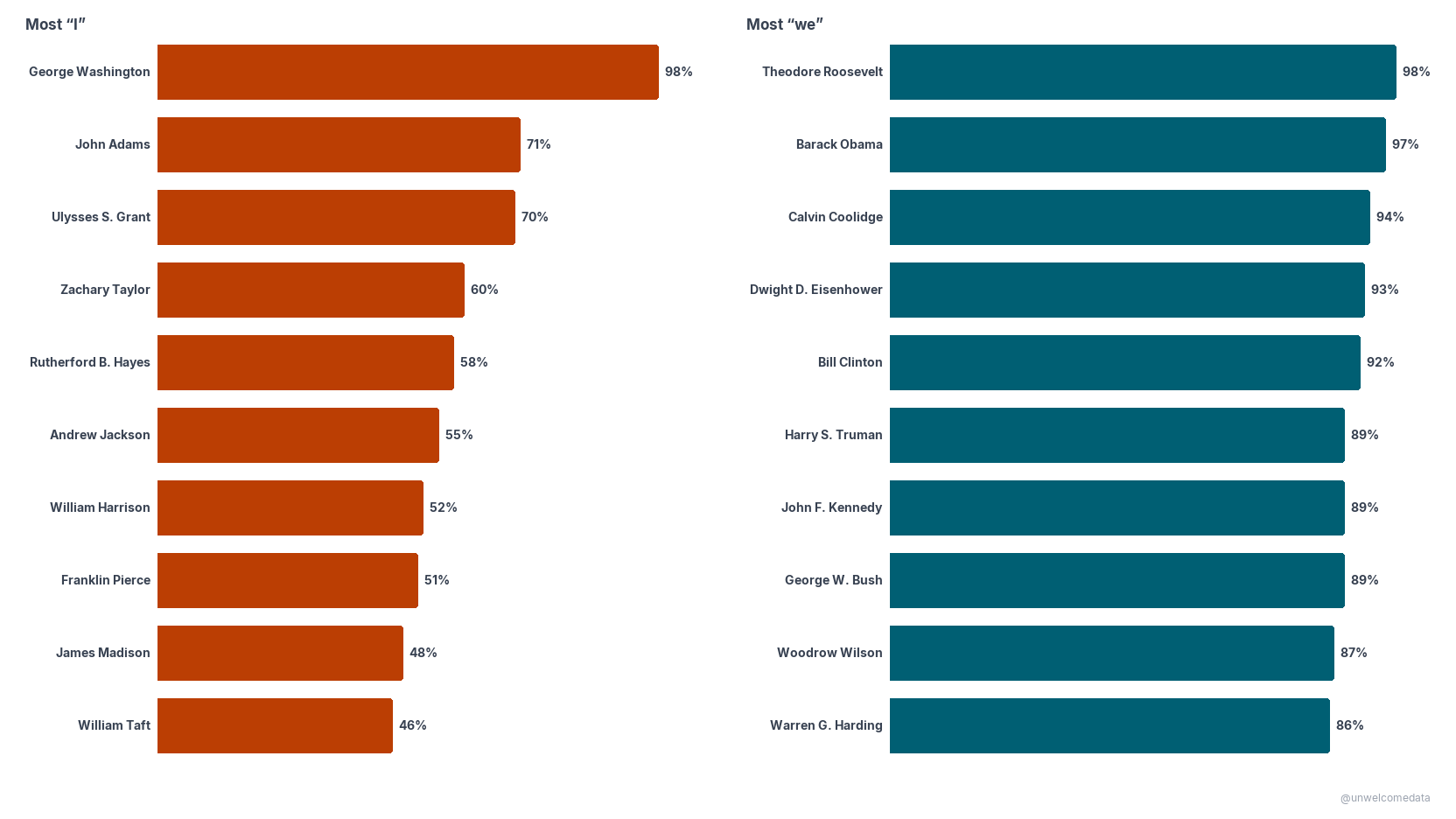
The “I” presidents and the “we” presidents (Inaugural addresses)
The same cut for inaugural addresses — left = most “I” (share that are “I”), right = most “we” (share that are “we”).
Every president’s lean toward “I” or “we”, chronologically (State of the Union)
All SOTU presidents (≥2 SOTUs) in time order, diverging from a 50/50 split: right leans “I”, left leans “we”. The percentage on each bar is the leaning side’s share.
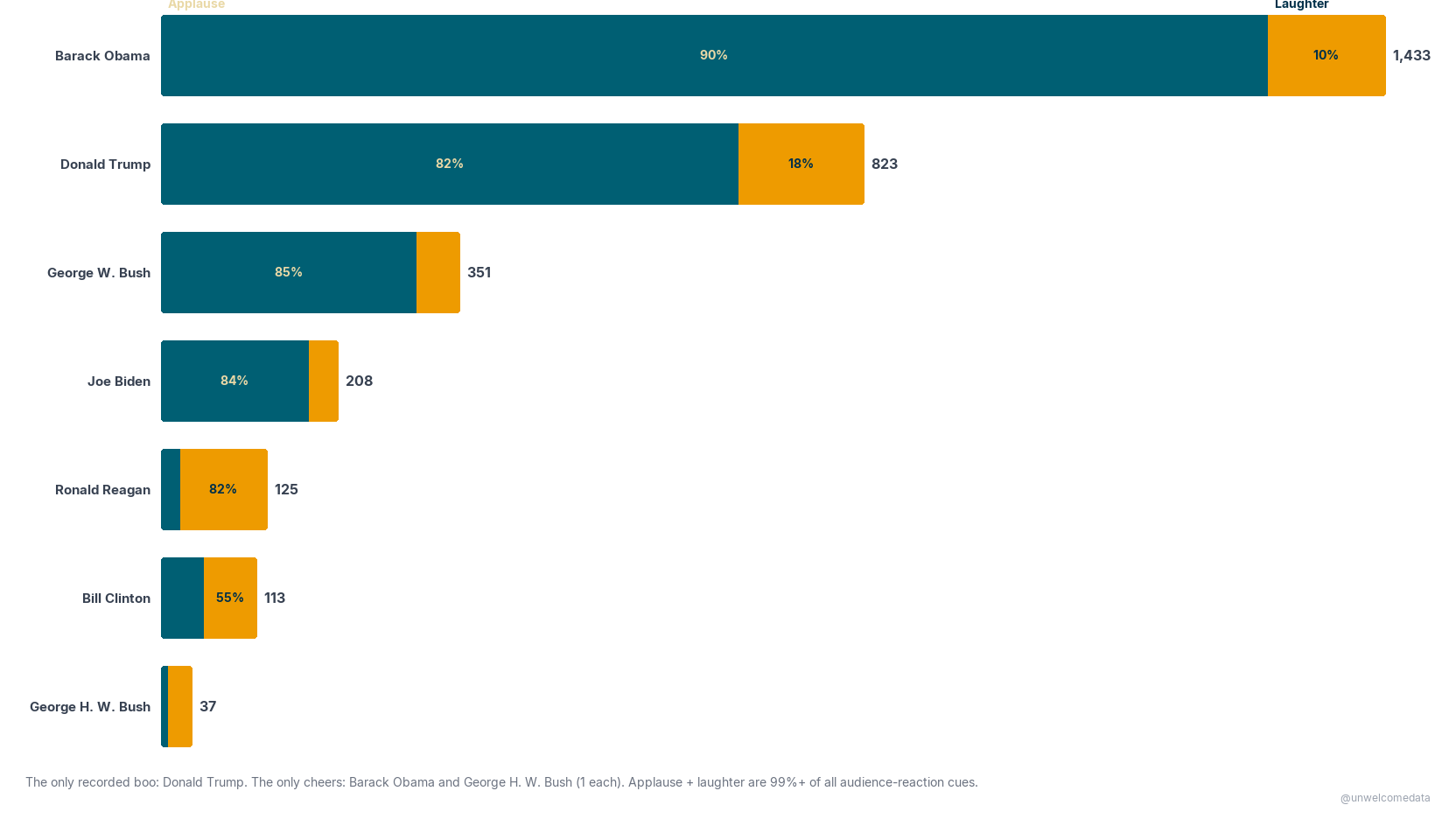
Applause and laughter
Transcriber markers of live audience reaction per president (presidents with ≥20 markers): applause vs laughter. Almost entirely a broadcast-era phenomenon.
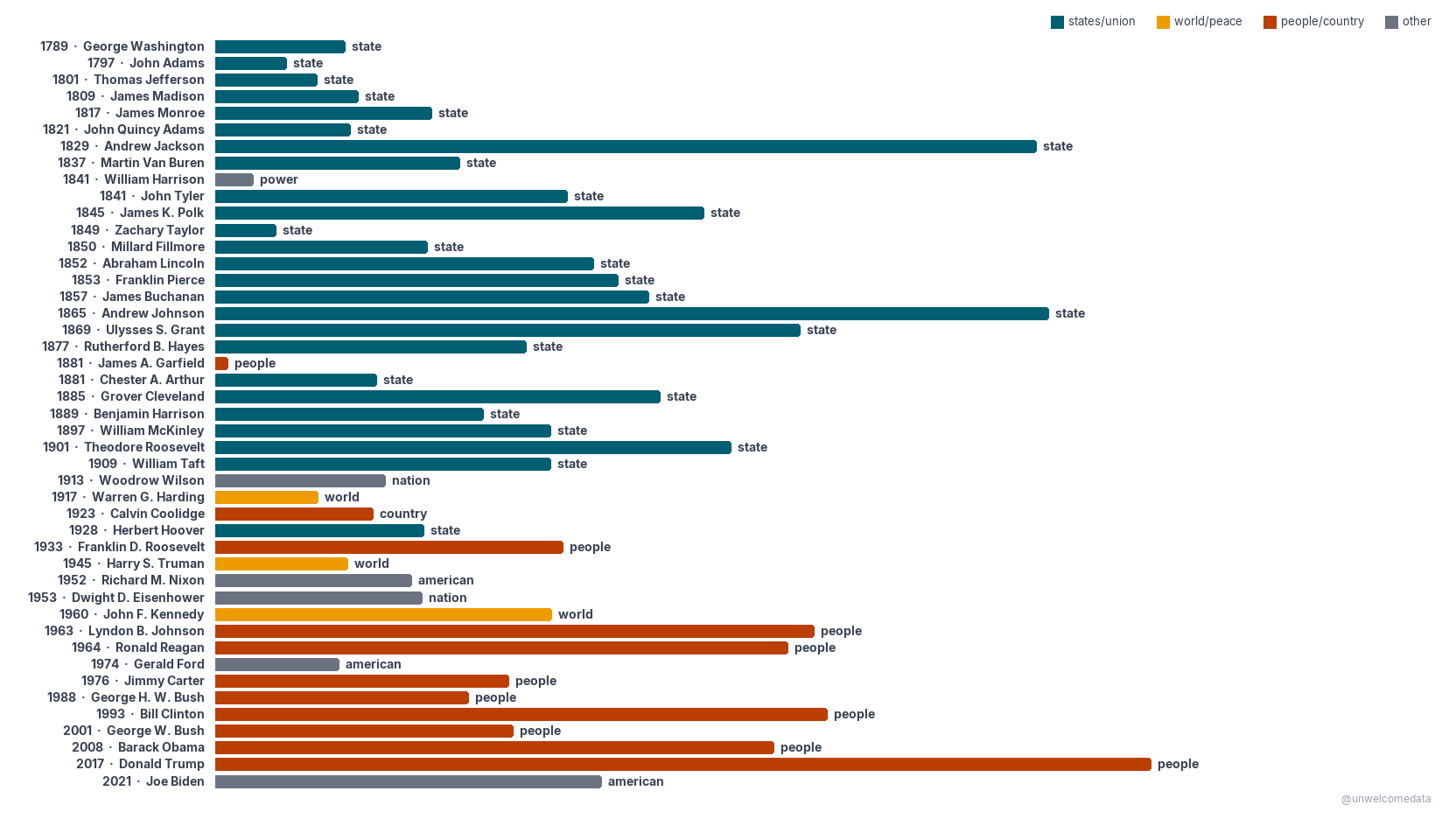
Every president’s most-used word, 1789→present
Each president’s single most-frequent word, in chronological order, colored by word-family. “State” dominates 1789–1909, giving way to “world” in the mid-century superpower era and “people” from the New Deal onward.
Additional charts (State of the Union average length by president; speeches-per-year
corpus coverage) are available in the repo (docs/).
Word clouds — every president, three ways
▶ Open the interactive word-cloud picker
Pick any of the 45 presidents and switch between three views:
- Distinctive — words a president used far more than other presidents (TF-IDF); their defining vocabulary.
- Most-used — their own most-frequent words (common function words removed).
- Phrases — distinctive two-word phrases (so “united states” stays one thing).
Clouds show only words the president actually spoke — transcription cues like
[Applause]/[Laughter], and speaker-label scaffolding like “president” from
Q: Mr. President attributions, are excluded (see How it was measured).
How it was measured
- Metric — self vs collective. For each speech, first-person pronouns are counted:
self = I, me, my, mine, myself (+ contractions); collective = we, us, our, ours,
ourselves (+ let’s).
self_share= self ÷ (self + collective); 0.5 is balanced. Rates are per 1,000 words so speeches of different lengths compare fairly. - Compared within one speech type. The corpus is curated and its coverage is uneven, so per-president comparisons are made within the State of the Union series or within inaugural addresses — never pooled across settings.
- A real series break. State of the Union messages were written and read by a clerk from 1801–1912, then spoken from 1913 on. Length and style change sharply at that break; charts note it, and length comparisons are read with it in mind.
- The early “I” presidents, in context. The most “I”-leaning presidents are 19th-century — which partly reflects the formal written-message style of that era (and, for a few, a smaller number of speeches in the corpus), not just personal disposition. Read the early end of the rankings as era-as-much-as-person.
- Words are counted transparently — a simple lowercase tokenizer (HTML entities decoded, tags stripped), an explicit stopword list, regular plurals folded to their singular (slave+slaves = one word), and transcription scaffolding excluded. No hidden NLP model; every count is explainable. Full detail in SOURCES.md.
- Frequency measures use, not stance. This counts what a president talked about, not their position — “no new taxes” still counts “taxes.” Negation and sentiment are out of scope for a transparent frequency method.
- Measured as delivered. Many speeches were ghostwritten; this analyzes the text as delivered, not authorship.
The data
- Download the dataset (CSV) — one row per
speech, with pronoun counts, rates,
self_share, speech type, and the written/spoken era flag. - Codebook — plain-English description of every column.
Reproduce it
The pipeline is committed in this repo. src/ holds the ingest, cleaning, and
feature/word-processing logic (src/prepare.py carries the transparent tokenizer,
plural-folding, and scaffolding exclusions); notebooks/ (on the main branch)
narrate each stage from raw archive to the published charts. config.yaml documents
the source and settings.
Sources & license
Primary source: the University of Virginia Miller Center curated presidential speech archive (public domain). Full attribution, collection method, definitions, the written/spoken series break, and known limitations are in SOURCES.md.
AI-Assisted Development This project was built with the assistance of Kiro, an AI-powered development environment. All data sourcing decisions, methodology choices, and published findings are the responsibility of the author. AI was used for code generation, data pipeline construction, and research assistance — not for analysis conclusions or editorial judgment.