Presidential Readability
@unwelcomedata · data from public sources
Have presidential speeches gotten simpler over time? Yes — markedly. This project measures the reading-grade level of U.S. presidential oratory across the spoken/broadcast era (1913–present) and finds a clear long-term decline: the State of the Union has fallen from a mid-teens/college reading level to around 8th grade today.
Reading grade is measured with Flesch–Kincaid (and three companion formulas as a cross-check). A higher number means more complex text — roughly, the U.S. school grade you’d need to read it comfortably.
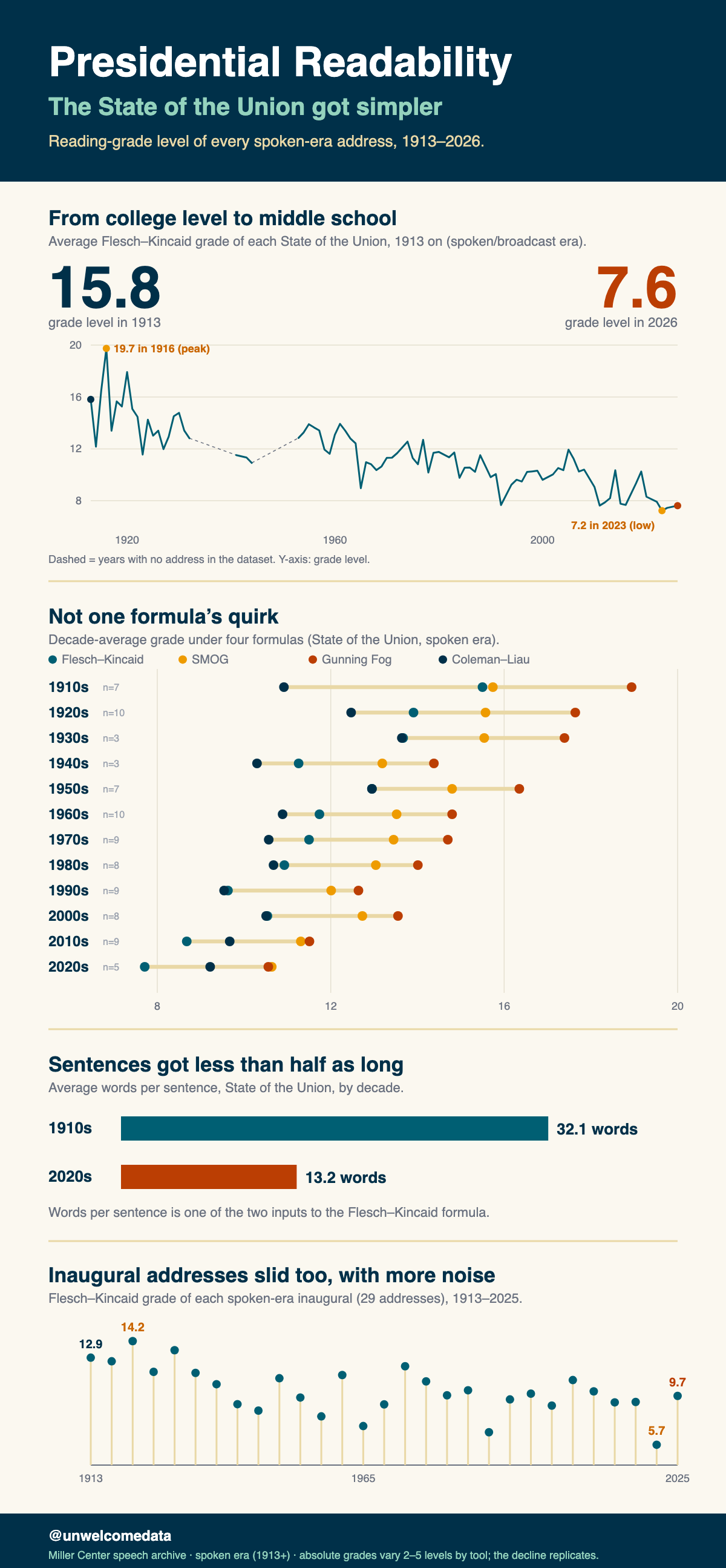
The State of the Union got simpler
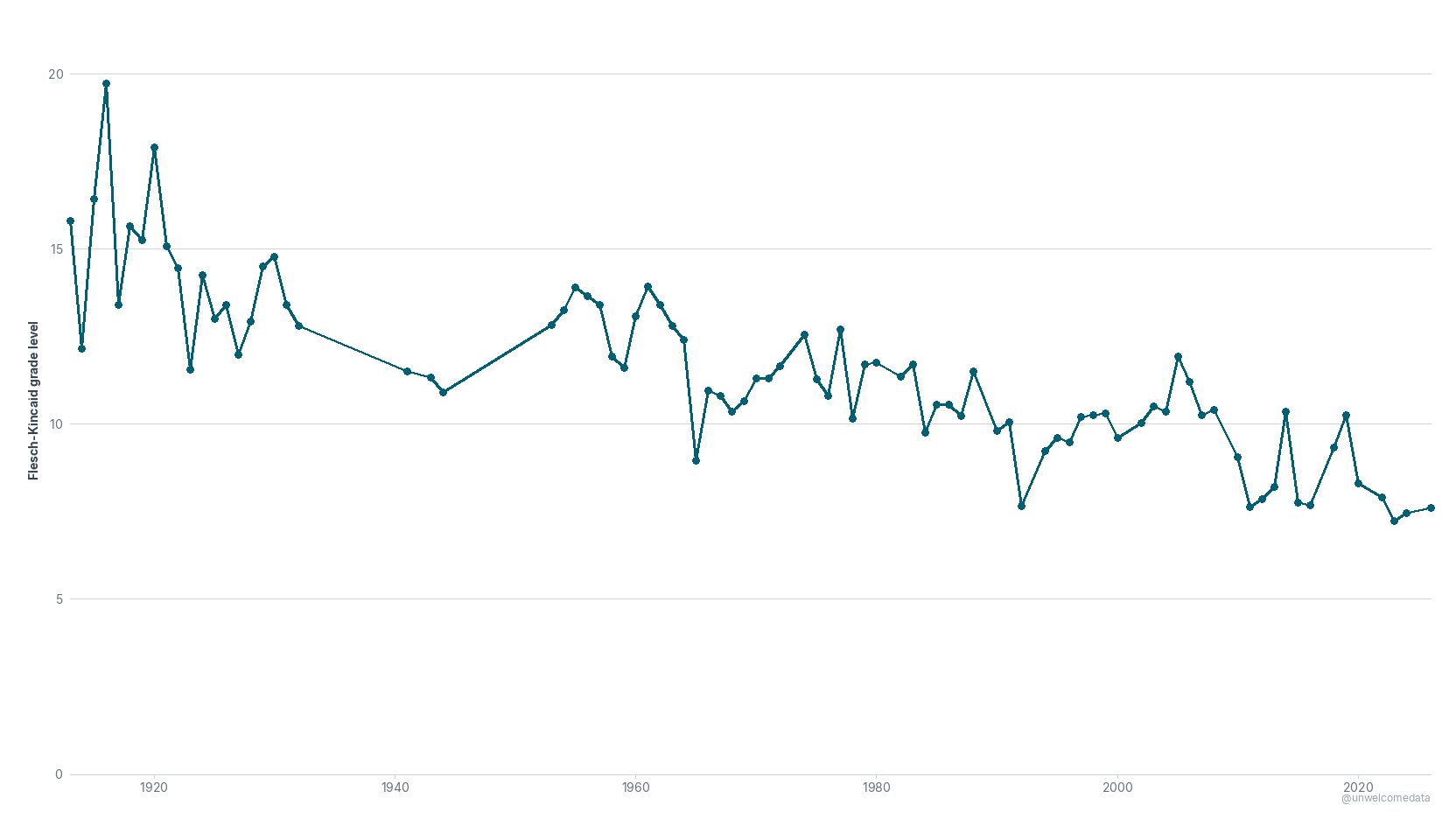
Average Flesch–Kincaid grade level of each State-of-the-Union address, spoken/broadcast era (1913 on). The series starts in 1913 on purpose — see How it was measured below.
Four formulas agree
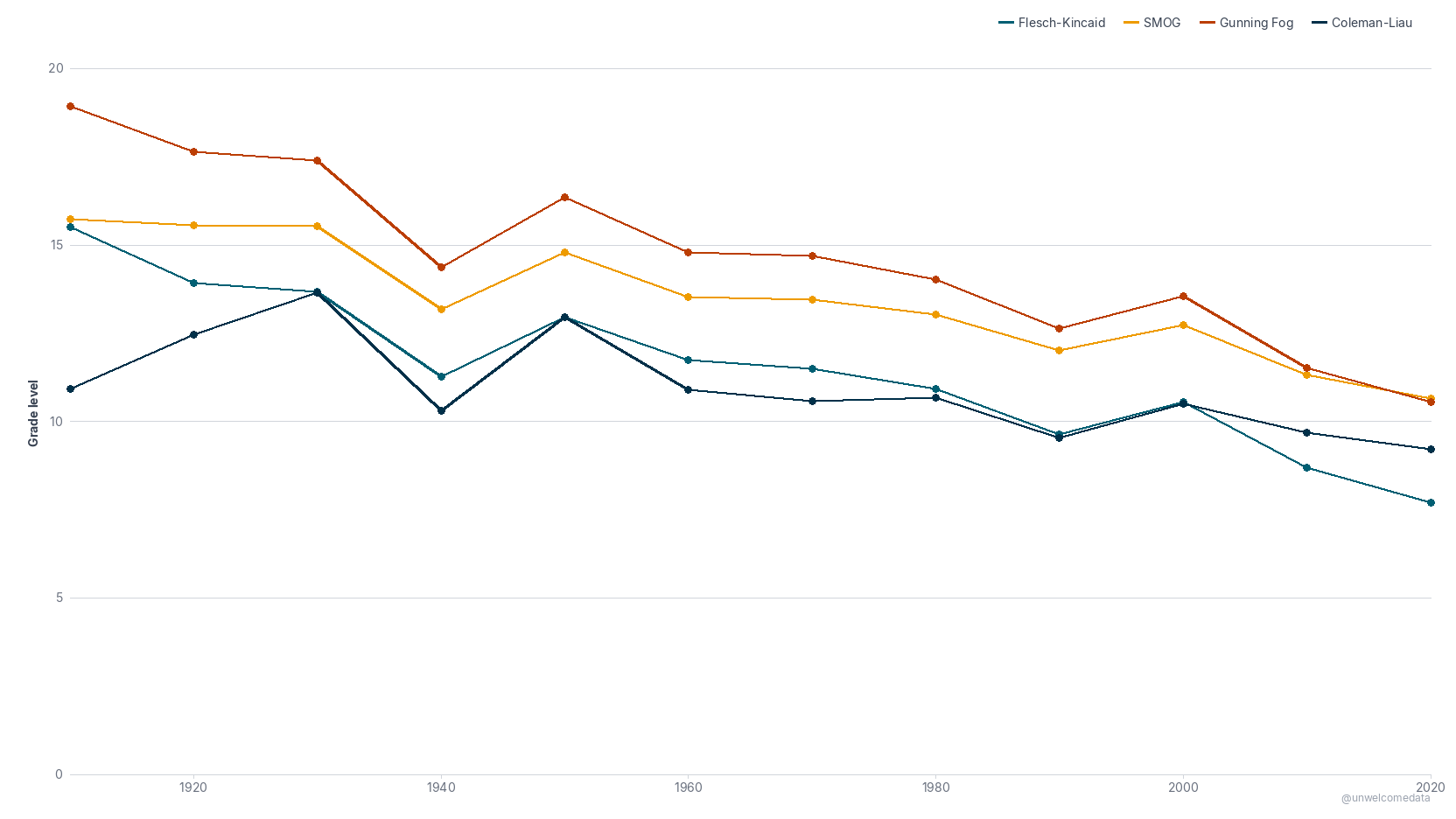
Flesch–Kincaid, SMOG, Gunning Fog, and Coleman–Liau, averaged by decade. They all trend the same way — the decline isn’t an artifact of one formula’s quirks.
Inaugurals too
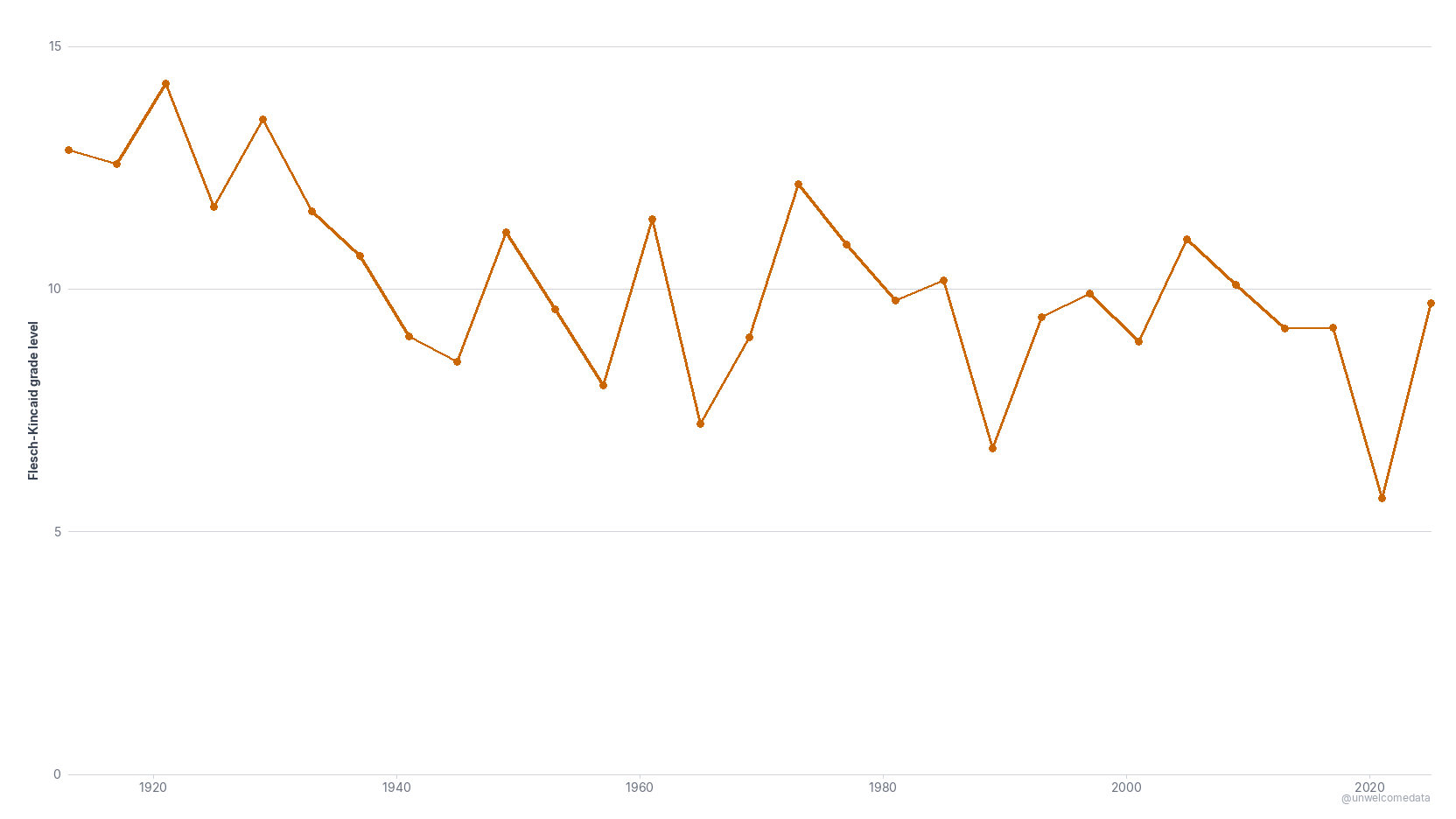
Inaugural addresses — a different, always-spoken speech type — show the same downward drift (noisier, since it’s one speech per term).
How it was measured
- Source: the University of Virginia Miller Center curated corpus of major presidential speeches (public domain). See SOURCES.md.
- Metric: Flesch–Kincaid Grade Level (lead), plus SMOG, Gunning Fog, and Coleman–Liau as companions. Grade formulas are computed from word/syllable counts and sentence counts from the NLTK punkt tokenizer (a reliable sentence splitter matters — see the caveats).
- What’s included: real delivered oratory only — the State-of-the-Union series (Annual Message + State of the Union) and inaugural addresses. Proclamations, veto messages, and other legal/administrative documents are excluded; scored as prose they produce absurd grades (one 1795 proclamation is a single 382-word sentence).
- Why it starts at 1913: before 1913, the annual message to Congress was a written
document read aloud by a clerk, not delivered oratory — and reading formulas are unstable
on those long, dense historical texts. 1913 (when in-person delivery resumed) is the start
of the comparable, spoken era. The downloadable dataset keeps the earlier written era too,
flagged with a
delivery_modecolumn.
Honest limits:
- Reading formulas measure only surface features (sentence length, syllables) — not vocabulary sophistication, ideas, or rhetoric. “Simpler to read” ≠ “less substantive.”
- Absolute grade levels are formula- and source-dependent. Independent analyses that use a different transcript archive typically land 2–5 grades lower, especially before 1980. Treat the numbers as a consistent index; the long-term decline replicates across formulas and across independent studies.
The data
- Download the dataset (CSV) — one row per speech, with each readability score, plus a codebook describing every column.
- Includes both eras (spoken 1913+ and the earlier written era) with a
delivery_modeflag, so you can filter as the charts do.
Reproduce it
The pipeline is a single standalone command (raw source → published export):
pip install -r requirements.txt
python scripts/reproduce.py        # Miller Center corpus -> clean -> readability -> export
python scripts/validate_charts.py  # re-checks the chart facts; exits 0 if all good
scripts/reproduce.py runs the same src/ logic the analysis uses, in order
(ingest → clean → prepare). Against the same archive snapshot it writes a byte-identical
export; the Miller Center updates its archive occasionally, so a fresh download can differ
slightly (see Corrections in SOURCES.md).
Sources & license
Full attribution, methodology, and series-break notes: SOURCES.md. Source corpus is public domain (U.S. government works); this project’s code and derived dataset are shared for public use.
AI-Assisted Development This project was built with the assistance of Kiro, an AI-powered development environment. All data sourcing decisions, methodology choices, and published findings are the responsibility of the author. AI was used for code generation, data pipeline construction, and research assistance — not for analysis conclusions or editorial judgment.