@unwelcomedata · data from public sources
Oscar wins by genre
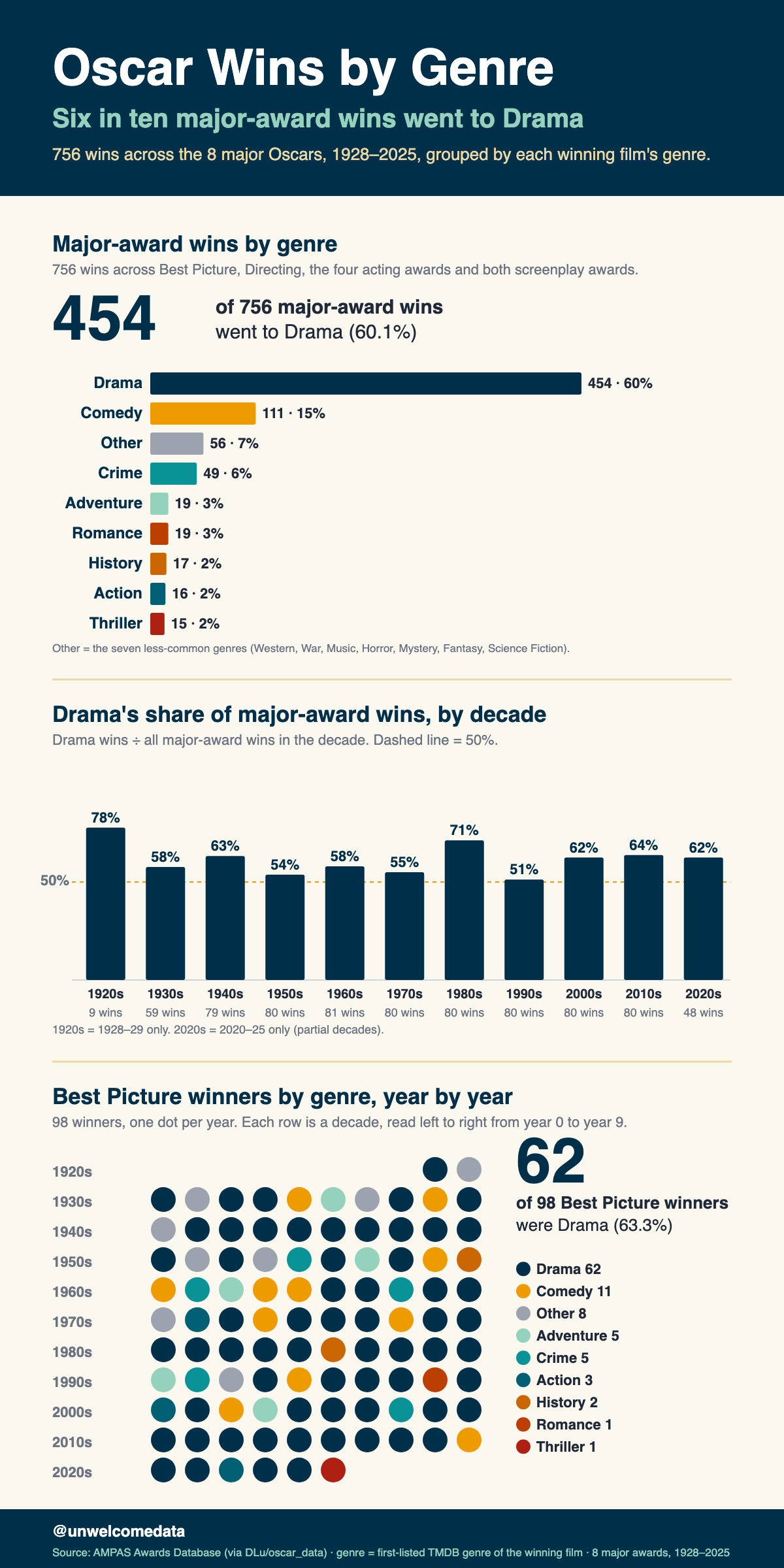
Every Oscar winner belongs to a genre — and across 98 ceremonies the Academy has had a clear favorite. Of the 756 major-award wins (Best Picture, Directing, the four acting awards, and the two screenplay awards), roughly 60% went to films tagged Drama (~454 of 756). Drama leads in every single decade, and the tilt is sharpest for Best Picture.
Click any chart to open it at full resolution.
How it was measured
The metric is major-award WINS, each colored by (or counted per) the winning
film’s primary genre. “Major awards” means the eight headline categories:
Best Picture, Directing, the two leading-acting and two supporting-acting
awards, and the two screenplay awards (Adapted and Original). Genre comes from
The Movie Database (TMDB) — specifically each film’s first listed genre
(genres[0]) — binned to the top 8 genres plus “Other” (9 colors). Oscar
nominations and winners are from the Academy of Motion Picture Arts & Sciences
(AMPAS) Awards Database (compiled by DLu/oscar_data).
This product uses the TMDB API but is not endorsed or certified by TMDB.
Two honest caveats worth keeping in mind as you read the charts:
- “Primary genre” is a single, first tag. Many winners are genuinely multi-genre, and a film you think of as something else may show up as Drama. The Silence of the Lambs is commonly tagged Crime / Thriller / Horror; Oppenheimer is Biography / Drama / History — but each is charted under its one TMDB primary genre only.
- The 2020s is a partial, in-progress decade — the data runs through the 2025 ceremony (the 98th), so its lower counts reflect fewer elapsed years, not a decline.
1. Every major win, by category and year
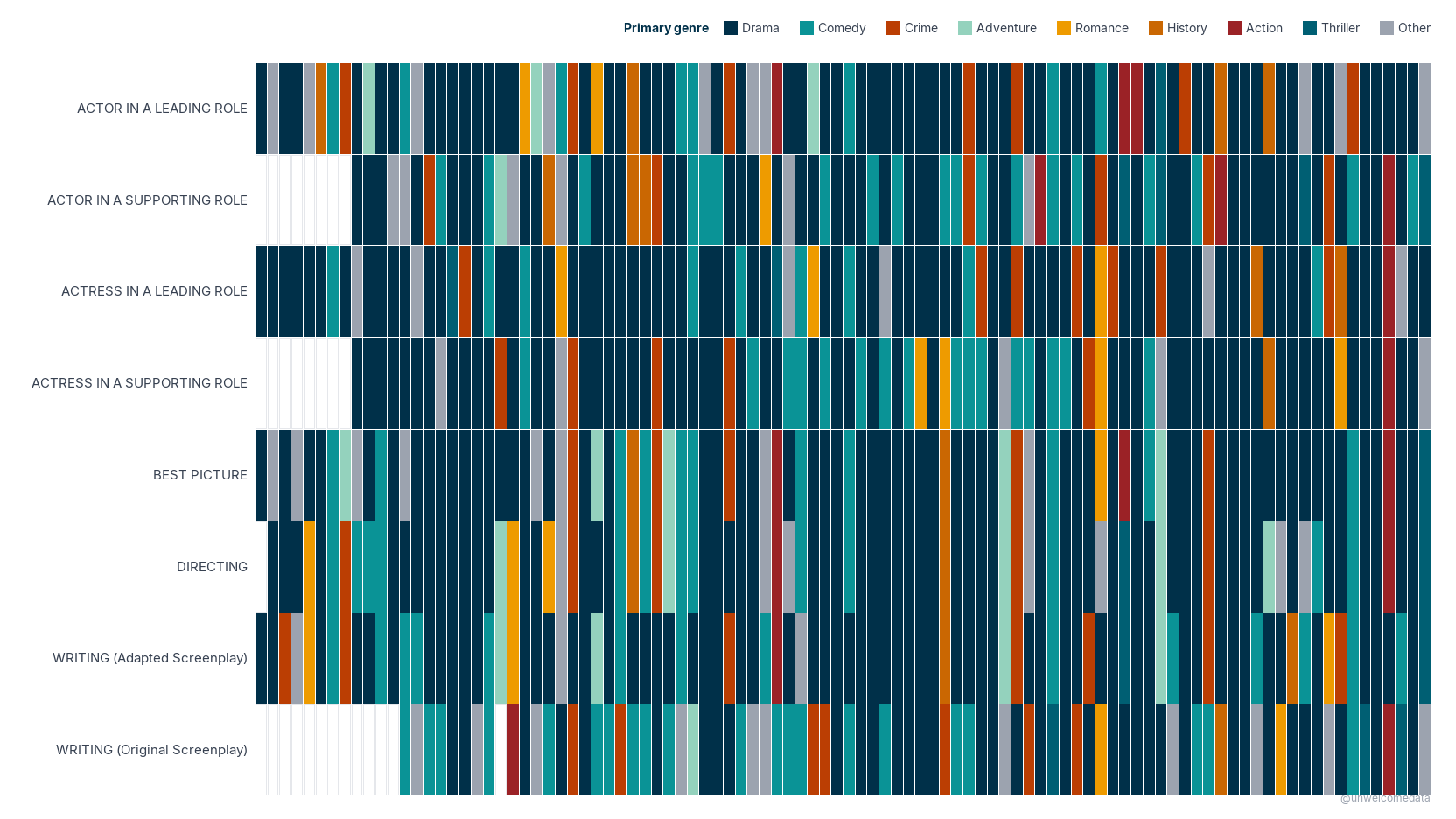
Each major-award win sits at its (category, year) cell, colored by the winning film’s primary genre. There are no numbers in the cells — the color is the information, and an empty cell simply means no major win for that category that year. The genre-to-color key sits in a single row above the grid.
2. Genre wins by decade — all major awards
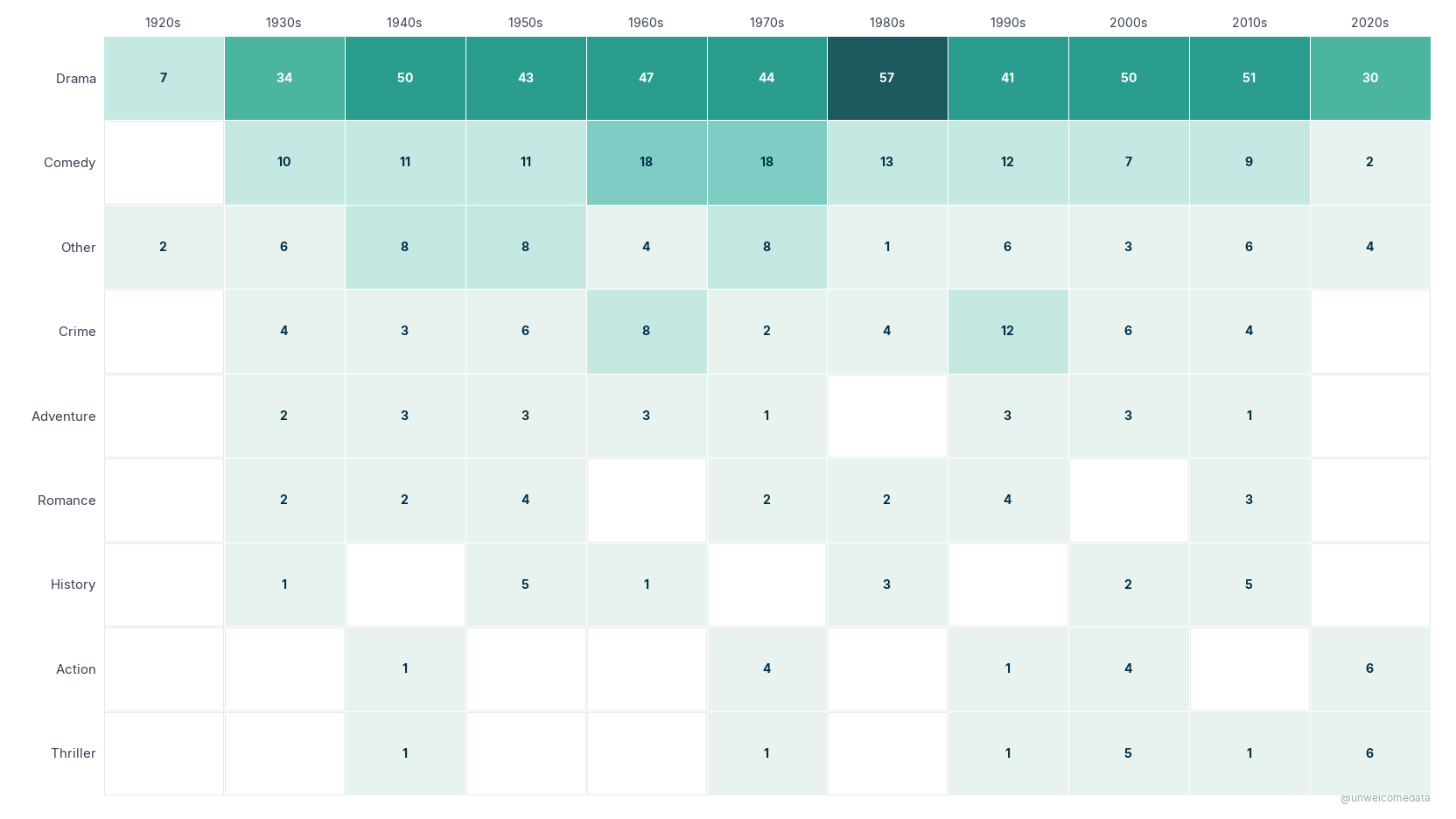
Each cell is the count of major-award wins for a given genre in a given decade, on a sequential teal scale (hotter = more wins). This counts all eight major awards together. Drama’s row runs hot across every decade; the empty cells are decades with no major win in that genre.
3. Genre wins by decade — Best Picture only
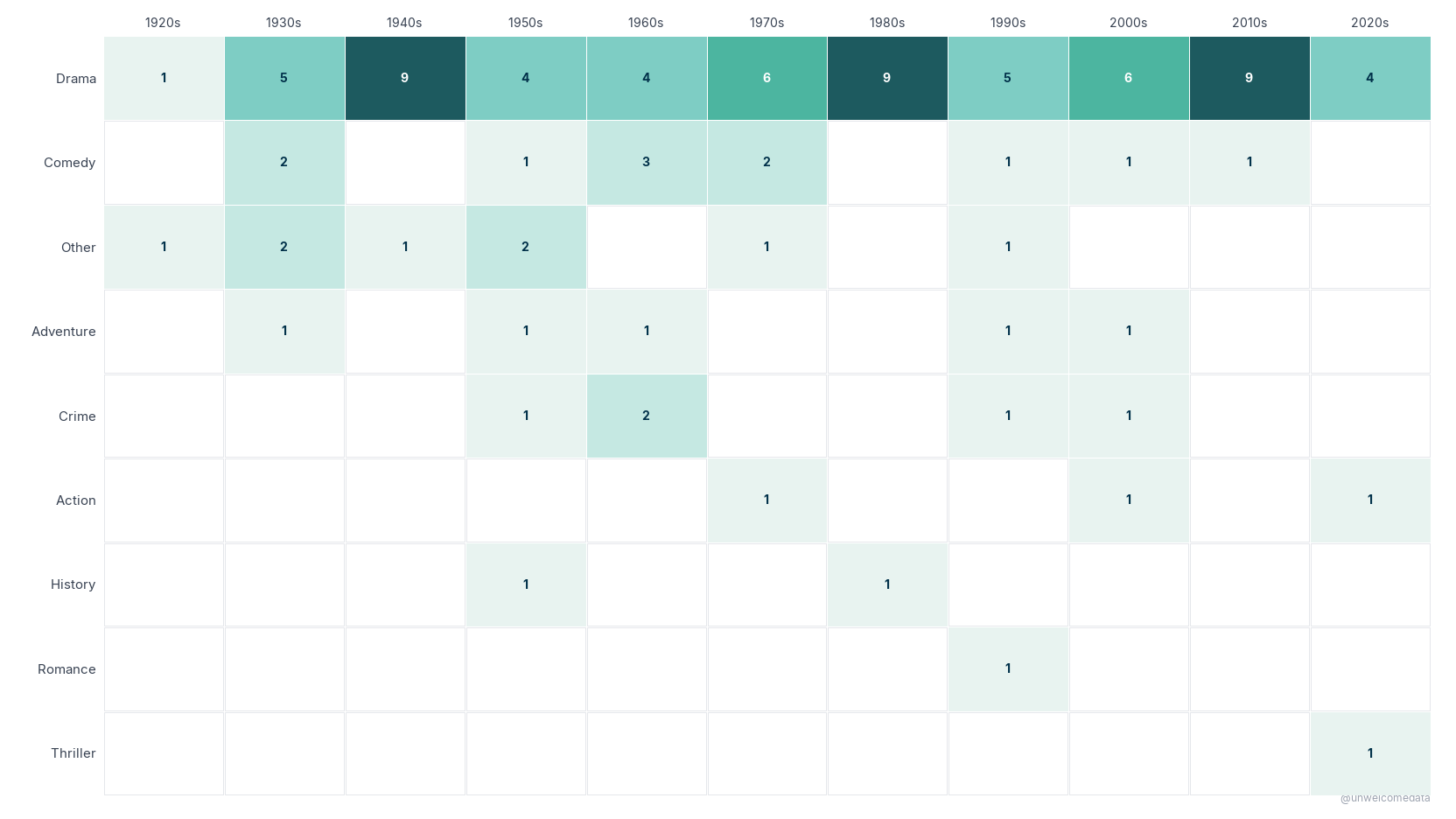
Same shape as chart 2, but this one counts only the 98 Best Picture winners — not all major awards. Stripped to Best Picture, the genre signature is tighter and more selective, but Drama still dominates the frame. (Read this as Best Picture alone, genre × decade count, sequential teal.)
The data
The full per-win dataset is published here:
- oscars_award_wins_v1.csv — one row per winning award, 1st ceremony (1927/28) through the 98th (2025), with ceremony, year, decade, award class and category, film, winner, and the TMDB primary genre (populated for major-award films).
- Codebook — a plain-English description of every column.
Sources & license
Full attribution and the methodology write-up are in SOURCES.md.
Oscar nominations and winners come from the AMPAS Awards Database (https://awardsdatabase.oscars.org/), compiled with IMDb identifiers by DLu/oscar_data (BSD 2-Clause for the compilation; underlying facts from AMPAS/IMDb). Film genres are from The Movie Database (TMDB) — this product uses the TMDB API but is not endorsed or certified by TMDB. This is a fun-tier pop-culture project; Oscar and film names are used nominatively.
AI-Assisted Development This project was built with the assistance of Kiro, an AI-powered development environment. All data sourcing decisions, methodology choices, and published findings are the responsibility of the author. AI was used for code generation, data pipeline construction, and research assistance — not for analysis conclusions or editorial judgment.